
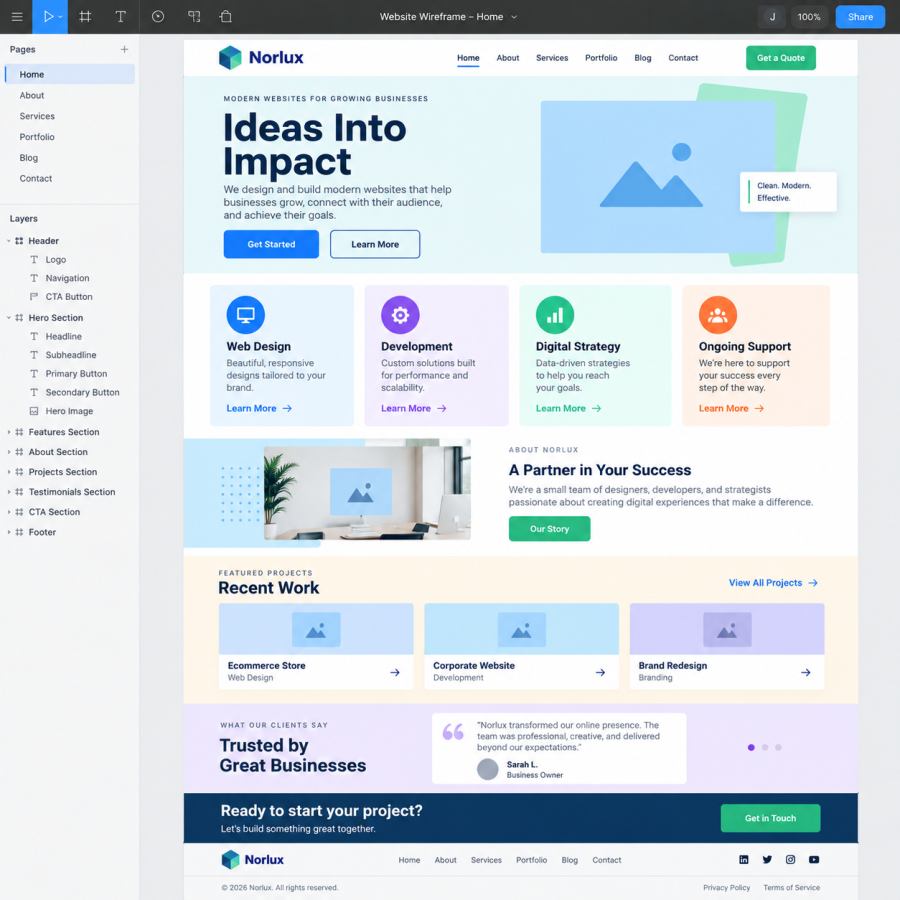
Designing a website is a complex process that involves much more than choosing attractive colours, fonts, images, and graphics. A successful website must also have a clear structure, intuitive navigation, logical content organization, and an effective user experience. One of the most useful tools for planning these elements before development begins is the wireframe diagram.
A wireframe is a simplified visual representation of a webpage or website. It focuses primarily on the arrangement and functionality of elements rather than their final visual appearance. Wireframes can range from simple hand-drawn sketches to detailed digital diagrams showing page layouts, navigation, content areas, buttons, forms, and interactive components. Used properly, wireframes provide an important bridge between an initial idea and a finished website.
One of the greatest advantages of wireframing is that it allows a website’s structure to be visualized before significant time and money are invested in development.
A written description such as “the homepage will contain a hero section, company introduction, services, testimonials, and a contact form” may sound straightforward, but it does not necessarily communicate how these elements should relate to one another. A wireframe transforms the description into a visual plan.
The designer and client can immediately see where major elements will appear, how much space they will occupy, and how users will move through the page. This makes abstract ideas much easier to discuss and evaluate.
A website should guide visitors toward the information and actions that are most important. Wireframes are particularly useful for establishing this information hierarchy.
For example, a business website may want visitors to:
Understand what the company does.
Learn about its services.
Review examples of previous work.
Contact the company.
A wireframe allows the designer to determine how these objectives should be reflected in the page structure. The most important information can be given prominent positions, while secondary information can be placed further down the page or on supporting pages.
This process helps prevent a common design problem: attempting to give every element equal visual importance. If everything is prominent, nothing is prominent.
Wireframes are also valuable for planning navigation. Before creating a polished website, designers can map out the relationship between pages and determine how users will reach important information.
A wireframe prototype can demonstrate menus, navigation bars, calls to action, buttons, forms, links, and other interactive elements. This makes it possible to identify confusing navigation paths before they become part of the finished website.
For larger websites, wireframing can also be used to create a page hierarchy. A designer might begin with the homepage, followed by major sections such as Services, About, Portfolio, Blog, and Contact. Individual pages can then be planned underneath these sections.
This provides a structural blueprint for the website and helps ensure that the eventual navigation system is logical and consistent.
Perhaps the most practical benefit of wireframing is that it makes problems inexpensive to fix.
Changing a layout in a wireframe may take only a few minutes. Changing the same layout after a website has been fully designed and developed can require considerably more work.
For example, a wireframe may reveal that a page contains too many sections, that an important call-to-action is difficult to locate, or that there is insufficient space for the client’s required content. These problems can be addressed before the designer spends hours creating detailed graphics and before a developer writes the corresponding HTML, CSS, JavaScript, or WordPress templates.
The earlier a design problem is discovered, the less expensive it generally is to correct.
Wireframes provide a common visual language between clients and designers.
Clients may have difficulty describing exactly what they want using technical or design terminology. A wireframe allows them to point directly to a section of a page and say, for example, “I would like this content above the image” or “This button needs to be more prominent.”
Likewise, designers can explain their reasoning visually rather than relying entirely on verbal descriptions.
This is particularly useful during the approval process. Instead of approving an entire finished design and then discovering that the underlying structure is unsuitable, the client can review the website’s architecture and layout at an earlier stage.
Another important advantage is that wireframes separate function and structure from visual styling.
When looking at a polished mockup, clients may naturally focus on colours, photographs, typography, shadows, gradients, and other visual details. While these elements are important, they can distract from more fundamental questions:
Is the information organized logically?
Is the navigation intuitive?
Is the call-to-action in the appropriate location?
Does the page contain too much information?
Does the layout support the website’s objectives?
A wireframe intentionally reduces visual distractions. It allows everyone involved in the project to concentrate on the underlying structure before decisions about detailed aesthetics are finalized.
Wireframes can also become interactive prototypes. Individual buttons, links, and navigation elements can be connected so that clicking them takes the user to another wireframe or page.
This creates a simple simulation of the website without requiring the entire website to be developed.
An interactive prototype can be tested with potential users, employees, stakeholders, or the client. Observing how people interact with the prototype can reveal usability problems that may not be obvious from a static design.
For example, users might repeatedly attempt to click an element that does not appear to be interactive, overlook an important navigation option, or have difficulty finding a particular piece of information. Discovering these issues during prototyping provides an opportunity to improve the design before development.
Wireframes can ultimately reduce development costs by providing developers with a clearer specification.
A developer who receives only a finished visual design may still have questions about how particular components are supposed to behave. A well-prepared wireframe can supplement the visual design by documenting page structure, component relationships, navigation, and intended functionality.
This is especially valuable for complex websites containing forms, ecommerce functionality, account areas, filtering systems, dashboards, or other interactive features.
A wireframe does not replace technical documentation, but it can significantly reduce ambiguity between design and development.
Modern websites must work across a wide range of screen sizes. Wireframing provides an opportunity to consider responsive behaviour before the final design is produced.
A designer can create layouts for desktop, tablet, and mobile displays and determine how elements should rearrange themselves at different screen widths. Navigation might change from a horizontal menu to a mobile menu, columns might become stacked sections, and certain elements might move or disappear.
Planning these changes during the wireframing stage can prevent responsive behaviour from becoming an afterthought.
Although wireframes provide structure, they should not necessarily dictate every visual detail of the finished website.
A useful wireframe establishes the relationships, hierarchy, content requirements, and functionality of the page while leaving appropriate room for the designer’s artistic judgment. Once the structural requirements are agreed upon, the designer can make informed decisions about typography, colour, spacing, imagery, animation, and visual style.
This balance is important. A wireframe should provide enough direction to establish what the website needs to accomplish without unnecessarily restricting the designer’s ability to create an effective visual solution.
Wireframe diagrams are one of the most useful tools available during the early stages of website design. They transform abstract ideas into visual structures, clarify navigation, establish information hierarchy, facilitate communication, expose problems early, and provide a foundation for usability testing and development.
Most importantly, wireframing shifts important design decisions toward the beginning of the project, when changes are relatively inexpensive. Instead of discovering structural problems after a website has been designed and developed, clients and designers can identify and resolve many of those problems while the project is still in its planning stage.
A wireframe is therefore more than a simple sketch of a webpage. It is a blueprint for the website’s structure and user experience. When used as part of a disciplined design process, wireframes can improve communication, reduce unnecessary revisions, control development costs, and ultimately contribute to a website that is clearer, more functional, and easier for visitors to use.